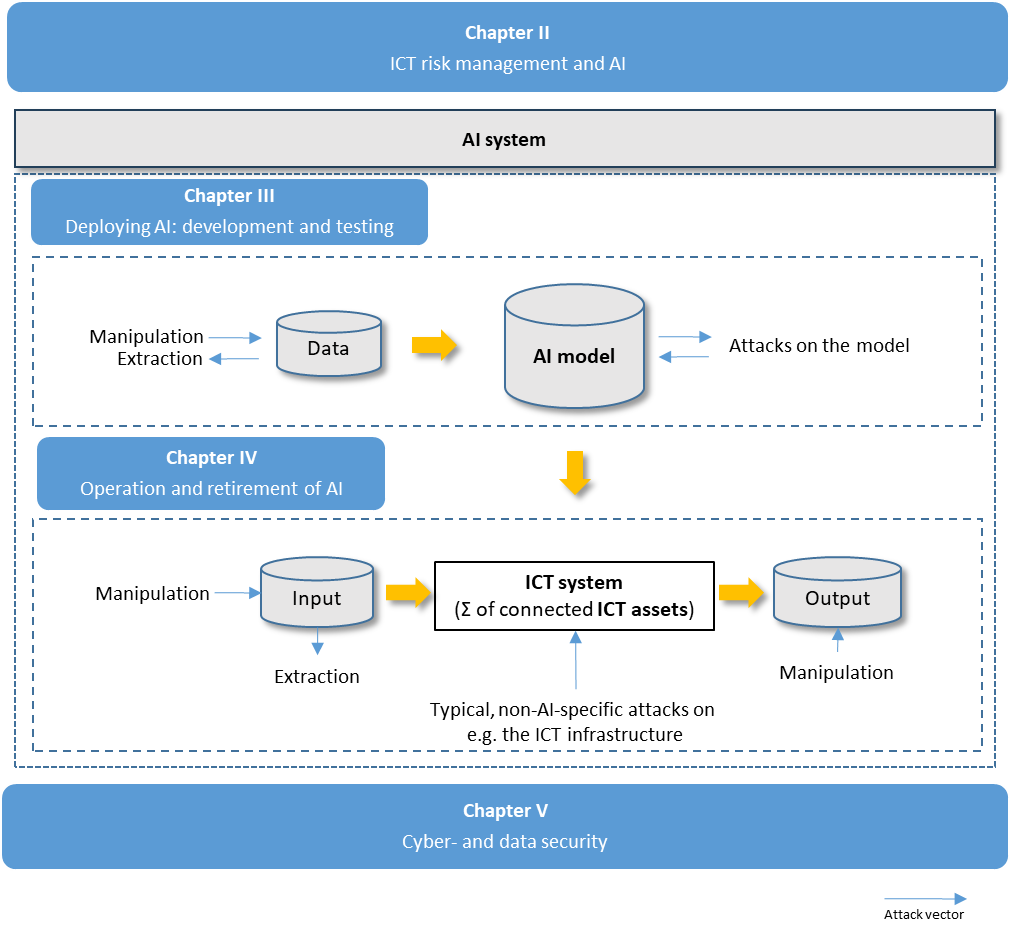
The observations on the security of AI systems are structured as follows:
First, key aspects relevant to ICT risk management (Chapter II) that apply across the entire lifecycle (see Figure 1) are described.
This is followed by discussions of the requirements for AI system development and testing (Chapter III), as well as for operation and retirement (Chapter IV). This includes the principal technical requirements for protecting the AI system. These chapters also consider data flow and ICT assets that are vulnerable to manipulation, data extraction and attacks (see data flow and attack vectors in Figure 1).
The subsequent chapter presents a discussion of generally applicable requirements for cyber- and data security in AI systems (Chapter V). Cyber- and data security aspects play a special role in this context, as they apply across all elements of the AI lifecycle. A final assessment summarises the most important information (Chapter VI).
This guidance document is intended to be a living document that can be adapted to reflect technological progress and new regulatory developments.